What are “TAQA” Qualifications?
What Does It Mean to Be a Qualified Assessor?
- A teaching qualification
- A Level 1 or Level 2 in assessment
- Any prior assessor training
- Experience working in education

Understanding the Four Level 3 Assessor Qualifications
There are four Level 3 assessor qualifications. The qualification you choose should match where and how you plan to assess. Here is a clear breakdown of the four options:
-
Level 3 Certificate in Assessing Vocational Achievement (CAVA)
This is the full assessor qualification and the most popular choice. To complete the course, you must have access to real learners to assess in both a workplace and a vocational training setting (such as workshops, classrooms or simulated learning environments). CAVA qualifies you to assess learners in both workplace environments and vocational training settings such as workshops, classrooms or simulated learning environments. If you are unsure where you will be assessing, or you want maximum flexibility, this is the qualification we usually recommend. It contains all three key units needed to assess competence and vocational knowledge.
-
Level 3 Award in Assessing Competence in the Workplace (ACWE)
This qualification is for those who will assess only in a real working environment. Examples include on-site assessments, apprenticeships, or job-based competency checks. If you are working directly with learners in their place of employment, this might be the most suitable option.
-
Level 3 Award in Assessing Vocationally Related Achievement (AVRA)
AVRA is designed for individuals who deliver or assess learning that takes place in a training environment, rather than a workplace. This includes classrooms, training centres, online learning platforms, or simulated workshops. It focuses on assessing vocational knowledge and skills through assignments, tests, and practical activities that are not carried out in the learner’s job role.
-
Level 3 Award in Understanding the Principles and Practices of Assessment (UPPA)
This is a theory-only qualification. It gives you foundation knowledge of assessment principles but does not qualify you to carry out assessments. It’s ideal for managers, internal staff who need assessment knowledge, or anyone preparing to move into a full assessor role in the future.
Who are These Assessor Courses for?
- College staff
- Independent training providers
- Workplace trainers and assessors
So, How Do I Know Which Assessor Course Is Right for Me?
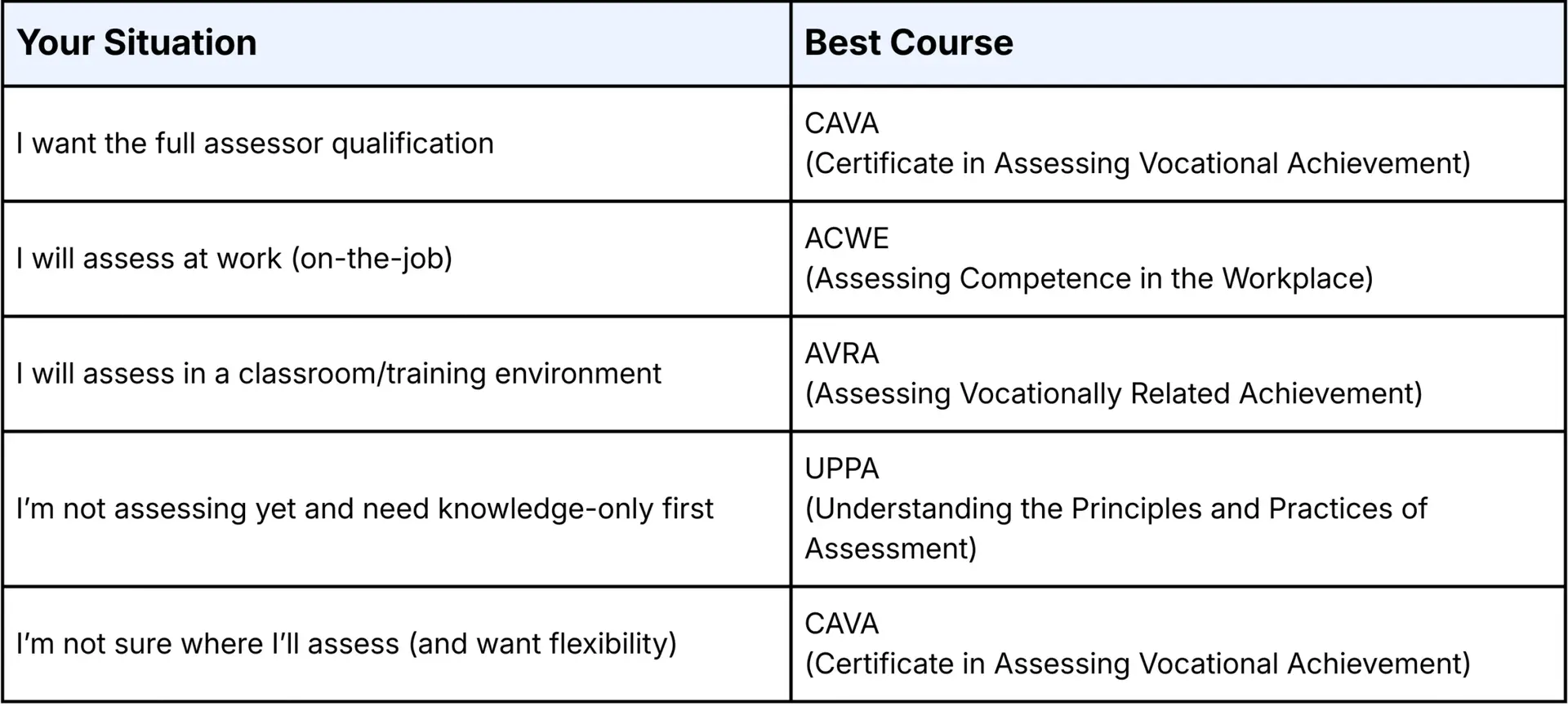
- If you want full flexibility, will assess in more than one setting, or simply aren’t sure — choose CAVA.
- If you will assess competence only in the workplace — choose ACWE.
- If you will assess learning in a training environment only — choose AVRA.
- If you want assessment knowledge without carrying out assessments — choose UPPA.
Why Train with ATC Training?
- Bulk discounts for teams and organisations
- Flexible study options — enrol anytime and complete by distance learning
- The option to arrange an online or classroom workshop for your team
- Extensive online training resources, with optional hard copy materials
- Fast certificate turnaround — typically within 7 days of completion
- An Ofqual-regulated qualification (RQF), recognised internationally